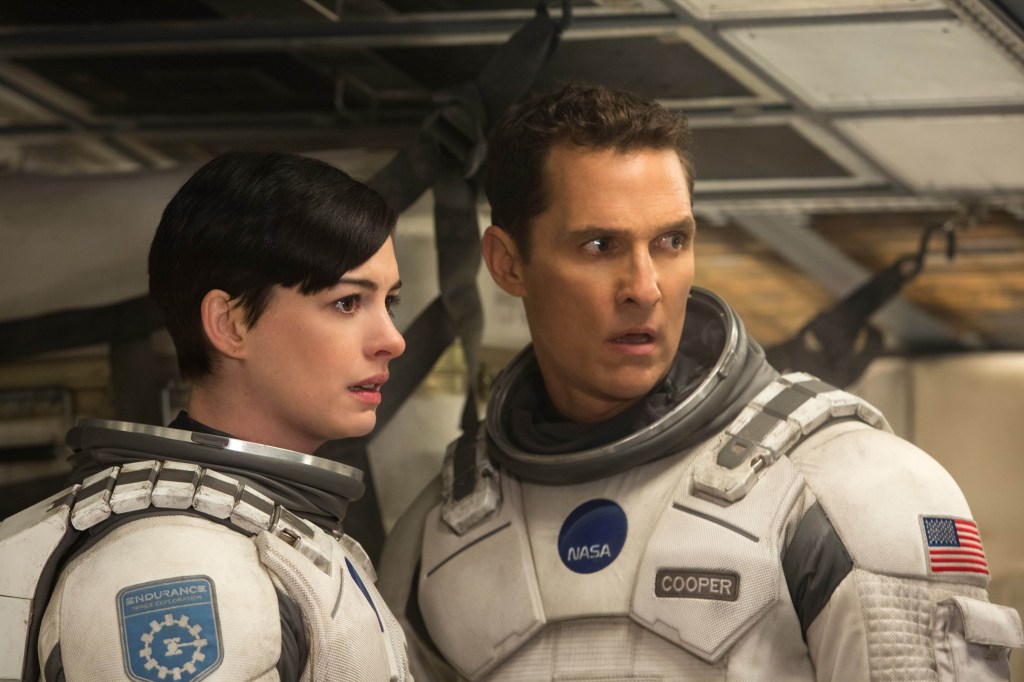
Photo via IMDb
9.5/10
You’re running late. Work is going by too slow. The event you’ve been dreading is fast approaching. Time is on a nonstop march with no destination. It marches regardless of what we do. We can try to stop it, speed it up, or elude it all together, but to no avail.
Christopher Nolan’s films are known to contain the motif of time. “Interstellar” portrays the ceaseless march of time and how it can affect a family spread across the galaxy.
Spoilers ahead for “Interstellar”
Cooper is an ex-pilot living on Earth in the near future. Society has collapsed and limited resources are available, specifically food. Cooper is a corn farmer, but realizes he and his family’s time on Earth is limited. After discovering a secret NASA base, Cooper volunteers to pilot a mission through a wormhole to explore potential habitable planets. He doesn’t know when, or if, he will return to his family, specifically to his young daughter Murph. He and his fellow explorers crash on a planet for only a couple hours, but due to extreme time dilation 23 years have passed. Cooper returns to the ship to discover his children are as old as he is.
They explore another potential planet only to be betrayed by the scientist previously stationed there. Cooper and Brand, another explorer, escape, but do not have the resources to make it back to Earth. Cooper sends Brand to the last potential habitable planet and sends himself beyond the horizon of the wormhole to acquire specific data. This data is to be relayed back to Earth to finish an equation regarding gravity to allow the rest of humanity to escape. He realizes that he can manipulate gravity through space and time and communicates with an older Murph back on Earth. He goes unconscious and is recovered by a space station. While there he reunites with Murph, who is elderly and on the verge of death as more time has passed. Murph helped lead everyone off Earth. She reunites with Cooper, but chooses to be with her family as she dies and instructs Cooper to search for Brand, as she is on the only habitable planet.
Losing and wasting time is a terrible feeling. It can be annoying to waste 20 minutes in traffic or to wait for the previews to finish before the movie actually starts. What is worse is realizing your time with the people you love has been wasted. “Interstellar” spans galaxies and decades, but reminds us of very simple things that everyone deals with on a daily basis. Our daily choices shape us and are the way we choose to spend the finite amount of time we are given. There is a constant chase to get more time, but we can never achieve it. Time is our most elusive resource. It is constantly slipping through our fingers.
Cooper doesn’t waste his time with his family, but chooses to sacrifice it for the good of humanity. How many could make that decision? When faced with stakes like that, I’m assuming not many. But how often are we presented with much simpler situations? Choose lunch with mom over playing the new video game. Calling your siblings instead of scrolling on Instagram. These decisions will not save humanity, but save us the eventual pain of knowing we squandered our time with those we love.
In the end, Cooper stares into the eyes of his aged daughter. He faces a situation that no one ever has; seeing the person their child has become long after they should have been gone. No one is able to see what they have left behind. Everyone must find solace in knowing they have done their best to equip their children, grandchildren or whoever with the knowledge to face this world.
“Interstellar” reminds us to pause every time we hear a ticking clock. It makes us consider how we spend our seconds, minutes, hours and years before all of our time has been spent.




 SZNS MAG