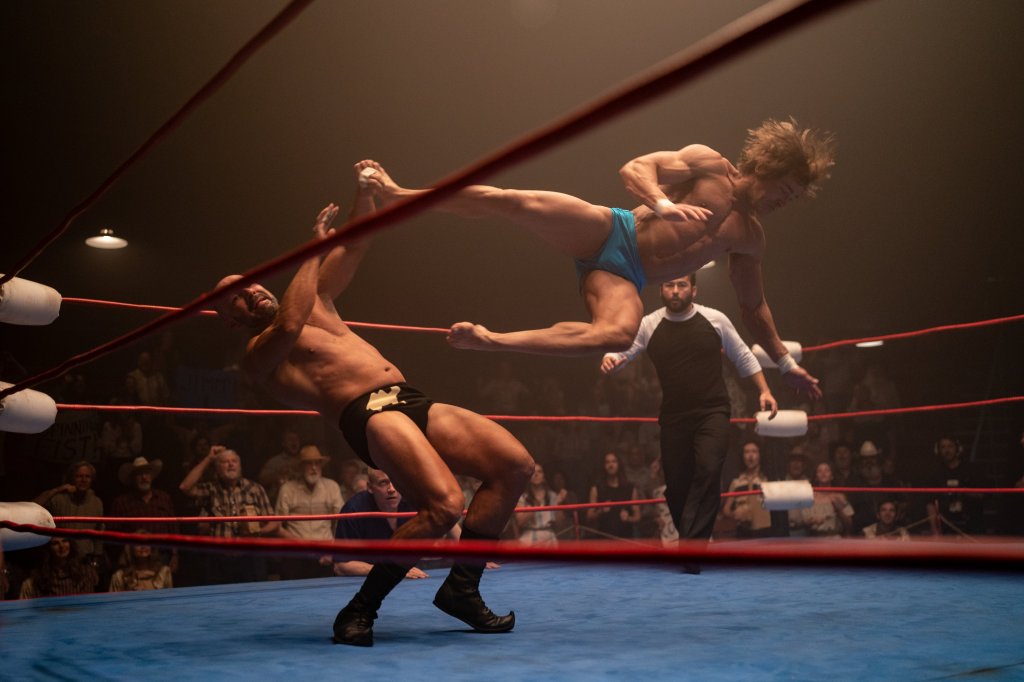
Photo via IMDb/A24
9/10
“The Iron Claw,” A24’s latest drama, delivers a message of brotherhood, domineering masculinity and self-discovery that will permeate through the heart of each audience member.
Based on the real-life Von Erich family, “The Iron Claw” follows brothers Kevin, David, Kerry and Mike as they navigate the hyper-competitive world of professional wrestling in the 1980s under the eye of their coach and father, Fritz.
Fritz, a former professional wrestler, seeks desperately to find success in his sons, pushing them to the brink, both mentally and physically, to be the best family the sport of wrestling has ever seen.
The cast is made up of an ensemble of established and upcoming actors. Zac Efron plays Kevin, the oldest brother, while Jeremy Allen White and Harris Dickinson play Kerry and David, respectively. Allen is coming off the success of FX’s hit show “The Bear,” while Dickinson’s recent notable acting credits feature 2022 films “Triangle of Sadness,” which was an Academy Awards Best Picture nominee, and “Where the Crawdads Sing.”
After the tragic deaths of his younger brothers, Kevin is left alone to process the trauma while Fritz continues to move along with wrestling. He feels no remorse for the deaths of his sons, which he indirectly caused through his intensity and lack of care. “Never let them see you cry,” he tells his remaining sons after every death.
Efron’s performance as Kevin is sensational. His ability to communicate joy and pain mixed with a sense of naivete lets the audience explore the depths of his emotional trauma. Kevin constantly looks on the edge of breaking down but is holding himself together not out of strength, but out of fear of his father.
The film expands on this with a tonal shift after David’s death. The film becomes much darker, adopting a tense, hold-your-breath type of tone that feels as if there’s a ticking time bomb counting down to the death of the next brother. Director Sean Durkin lays out the clues to the next death, and we’re faced with tragic realizations as it becomes apparent which brother will die next – and there’s absolutely nothing we can do about it.
Kevin and Fritz soon clash, with Kevin continuously being put down by his father. He is a larger-than-life professional wrestler, with a hulking body and the intensity to match it. However, outside the ring, he has accomplished nothing. He’s kept in the shadow of the wrestling ring his father has put him in.
Kevin eventually moves on, not through yelling or arguing with his father, but by distancing himself altogether. He sells the wrestling promotion company and moves away from the sport.
This is a distinct example of a generational change in masculinity that “The Iron Claw” develops so well. As times change, so does the world’s definition of masculinity. Kevin returns to his wife and children after time away. After being suffocated by his father and blamed for the deaths of his brothers, Kevin finds freedom in his own sons and lets them be free. Kevin’s embodiment of his masculinity – forgiveness, care and kindness – is in stark contrast to his father’s characteristics of competitiveness, desire for victory and aggression.
The final scene of the film finds Kevin sobbing while watching his sons play catch with a football. His sons notice and run to comfort him. “I used to be a brother, and now I’m not,” Kevin explains to his sons. “It’s okay, Dad, we cry all the time,” his son says. “We can be your brothers.” Kevin’s use of his raw trauma to connect with his sons displays far more emotional intelligence than his father ever had. And what is more manly than raising good, strong children and caring for your family?
“The Iron Claw” explores the perils of hyper-competitiveness and toxic masculinity. It’s a sad picture of death, with the only silver lining coming from the realization of one’s self. Kevin, through his realization, saves his children from the generational trauma inflicted upon him by his father in the form of outdated ideals and the incessant pursuit of those roles.
Within all of this is a lesson for domineering parents and hyper-masculine fathers – let your kids be kids, and love them for simply being who they are.


 SZNS MAG