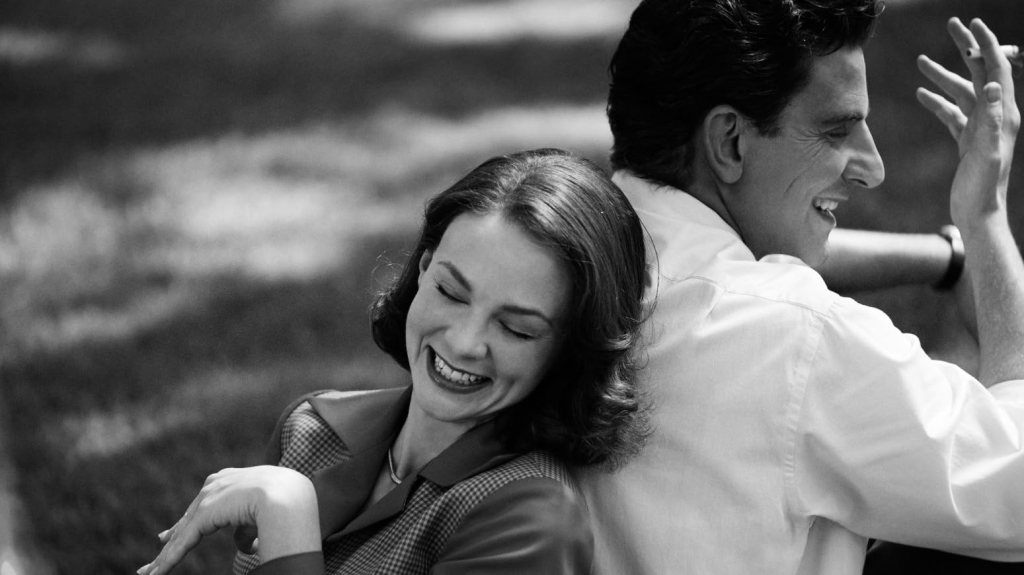
(Photo via Jason McDonald/Netflix/IMDb)
8/10
Classical music can be inaccessible and stuffy in isolation, but experienced in a live, community setting, it can be an uplifting, inspirational experience. A conductor, while technically ancillary, is the strongest performer you need. Conductors lead, they cue, but their primary responsibility is to bring the audience and the music together. To provide a feeling of transcendentalism, they need to feel it too. That passion is thrilling to see, and though he isn’t the strongest character here, “Maestro”’s Leonard Bernstein doesn’t miss a beat.
“Maestro” is a 2023 Netflix biopic of Leonard Bernstein, a New York City composer who gained fame at age 25 when he was thrust into conducting the New York Philharmonic Orchestra in 1943 as assistant conductor. Bradley Cooper directs and stars as Bernstein, while Martin Scorsese produces. Carey Mulligan, Maya Hawke, Matt Bomer and Sarah Silverman co-star.
This film shows Bernstein as a musician, theorist, teacher and coach. Not only does he prepare meticulously for each performance, but he builds a bridge to the emotion of each piece. Bernstein created scores for the 1954 film “On The Waterfront,” starring Marlon Brando, the 1956 adaptation of Voltaire’s “Candide” and the 1957 play “West Side Story.”
Cooper plays Bernstein as a highly animated and bohemian man. Cooper’s makeup — specifically his false nose, which stirred controversy but was ultimately approved by the Bernstein family — is completely invisible. Only by looking for it do you see it, and Cooper sacrifices very little of his expressiveness. His mannerisms while conducting are full of strength — not just for his wild, sudden motions on each downbeat, but for the upbeats as well. Berstein’s eyes brighten, his smile grows and his body floats as he dictates each note, as if he’s producing the sound of the orchestra from his head.
Scenes of Bernstein’s craft are strong, but a clear second to Carey Mulligan’s Felicia Montealegre, an actress and Bernstein’s wife. Though this could be interpreted as a misstep of the film, I consider it the best-case scenario. While Cooper and Mulligan provide great development of their characters, Felicia’s life is a more interesting and tragic story and is arguably worth telling more than Bernstein’s.
Her and Bernstein’s early relationship is sweet, and their years-long journey to marriage gives them plenty of time to mature as a couple and as characters. It kills Felicia to sacrifice her career and raise her family, and Bernstein’s open infidelity enrages her. She chooses to separate from Bernstein and recommit herself to her career, which proves to be a success. In her own time, she reforges her marriage to Bernstein, only to be diagnosed with breast cancer soon after.
Mulligan’s portrayal of Felicia during her fight with cancer is a standout point of the film. Not only does her sickness elicit a strong performance from Cooper, but the story’s tone shifts as well. The tension crescendoed — it was clear the downbeat was coming, and now it has.
Bernstein is a notable figure in history but isn’t as intriguing here. He’s a self-important artist whose arrogance alienates others. This might be historically accurate, and he does show his selflessness to Felicia in her final days, but it’s mostly a played-out characterization of an artist. I much prefer Mulligan’s journey, so much so that I would argue she is the film’s true lead.
Maya Hawke delivers a workable performance as Jaime, the eldest daughter of Bernstein and Felicia. Subjected to Bernstein’s celebrity and high society friends, Hawke portrays discomfort expertly. It’s a good device for the film to demonstrate the inherent failings of Bernstein as a husband and father, but it doesn’t leave much range for Hawke to explore. It’s a shame since the audience has seen her dynamic range portrayed in “Stranger Things.”
The aspect ratios, film quality and color palettes shifting as time marches on is a great mood-setter. The ‘40s and ‘50s are in 4:3 and black-and-white, the ‘70s are faded and textured, keeping in tone with Bernstein’s fading priorities, and the “present day” of the ‘80s are deeply saturated in 16:9 widescreen. The choices are intentionally noticeable, but effective in their meaning to the audience, representing the eras of Bernstein’s life and attitudes towards those periods.
And of course, music is a major factor. Bernstein’s work provides the bulk of the soundtrack, performed by the London Symphony Orchestra and Yannick Nézet-Séguin, while other composers make occasional appearances, demonstrating Bernstein’s influences. A few pop songs also make a welcome addition, specifically Shirley Ellis’ “The Clapping Song” and R.E.M.’s “It’s the End of the World as We Know It (And I Feel Fine),” featuring its not-so-subtle lyrics referencing Bernstein.
However, the ending of “Maestro” is a dud. It’s as if at the end, the movie realized it began with Bernstein in the ‘80s. Not knowing how to top Mulligan’s performance, we’re rushed back to the ‘80s and treated to Bernstein’s affair with a student and an awkward clip of ‘40s Felicia staring at us. It felt as if there was more movie to see, but was left on the cutting room floor.
“Maestro” delivers musically and visually, but struggles with prioritizing its two leads. Mulligan and Cooper are incredible as their characters, and their interactions together make for strong scenes, but we care more for Felicia than we do our Maestro. It makes for a great viewing experience, if only by accident.
“Maestro” has been nominated for Best Picture at the 96th Academy Awards, broadcasting March 10 on ABC, 7 p.m. CDT. Other nominees include “The Holdovers,” “American Fiction,” “The Zone of Interest,” “Barbie,” “Oppenheimer,” “Poor Things,” “Past Lives,” “Anatomy of a Fall” and “Killers of the Flower Moon.” For more about Best Picture nominees at the 96th Academy Awards, keep reading SZNSMAG.com.


 SZNS MAG