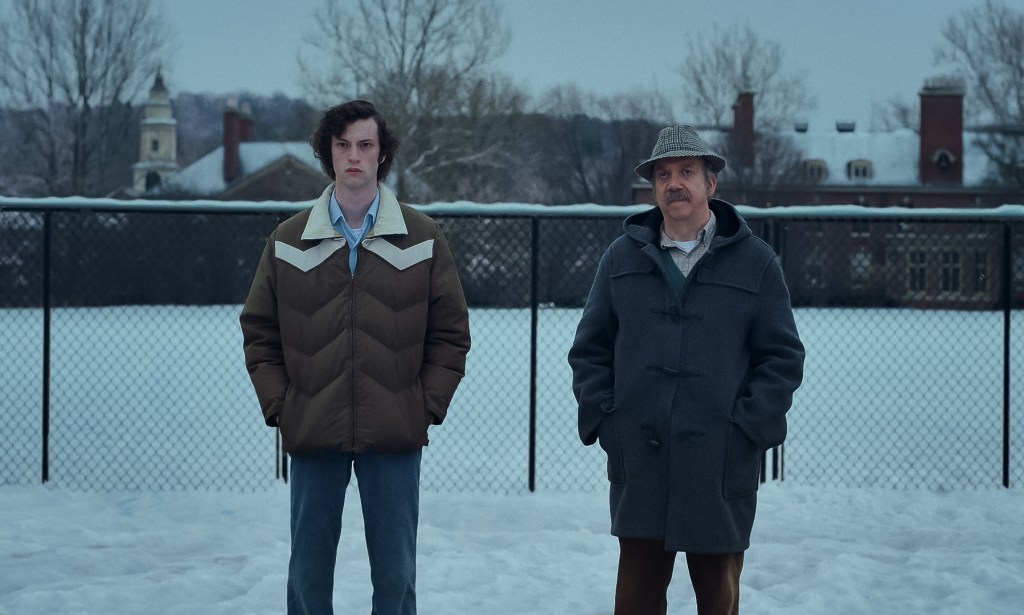
(Photo via Miramax)
7/10
I’m surprised with “The Holdovers.” Surprised by the overwhelming praise, I should say.
The setting, visuals and acting are, for the most part, at the top of their form. Barton Academy is a snobbish, yet warm refuge in the blisteringly cold New England winter, and co-leads Da’Vine Joy Randolph and Dominic Sessa are fantastic in their roles as cafeteria manager Mary Lamb and student Angus Tully, respectively. Paul Giamatti as the lead, Paul Hunham, is a crotchety classics professor – a man who’s lived life through the pages of text, rather than the people or places he admires.
“The Holdovers” follows these characters through the Christmas break of 1970-1971. Tully, along with four other holdovers at Barton, are left at the school and supervised by Hunham, who is left behind as their chaperone.
Despite being fully realized characters with backstories, motivations and potential for growth, four of the students exit the movie early. After six days, the wealthy father of a holdover arrives via helicopter, inviting the students on a family ski trip. Because Tully’s mother is unreachable, he’s forced to stay behind. Why even meet these kids? After sitting through twenty minutes of origin stories and minor development for each student, we’re asked to forget it by the 30-minute mark.
Giamatti has expressive characters in “Big Fat Liar,” “My Best Friend’s Wedding” and “Fred Claus,” but that expressiveness doesn’t seem as natural with Hunham. Since Hunham lives through the written word, he’s spent his whole life learning by rote. While he talks articulately about literature and history, he’s a parrot for the wisdom of others. As an individual, Hunham is insecure, prone to drinking, desperate for authority and overdramatic when he has it.
In quieter scenes, I wish Hunham spoke more organically – no quotes, no historical anecdotes and no performative speeches. He feels most accessible to the audience in moments of downtime, but the character is constantly reciting a mental script. It hurts the actor’s performance and keeps us from seeing Hunham as a human being. It might make sense for the character, but it doesn’t sustain my belief in Hunham as a real person.
Randolph’s Lamb, on the other hand, is fully realized. Mourning the death of her son in Vietnam, cafeteria manager Mary Lamb is facing her first Christmas alone. She spends it serving the holdovers, and later with Tully and Hunham, and acts as a natural point of connection within the group. Though Hunham never asks for help and Lamb never sets out to teach him, her experience as a parent gives her unique authority over him, and her advice on communicating with Tully proves crucial. Most of the story’s momentum comes from Lamb’s input and never compromises in showing her development. She’s allowed to step away from everyone, spend time with her sister, drink, cry, outwardly grieve her son and, eventually, return to everyday life. Randolph more than earned the Screen Actors Guild Award for Female Actress in a Supporting Role, received yesterday.
Speaking of drinking and crying, the Christmas party is a clear highlight of “The Holdovers.” Between Tully’s first kiss, Lamb’s public breakdown and Hunham’s misinterpretation of the host’s friendliness, this night could have been the whole movie. Everything we need to know about the cast is here, and there’s more than enough room for development. A tighter story in this setting could have made for a great experience, replacing what was otherwise a meandering 133 minutes.
Tully is very well acted by Dominic Sessa, and while I think his character benefits Hunham’s story more than his own, his entitlement and enjoyment in disrespecting his chaperone is very entertaining. It makes sense to use a rebel to challenge authority, and the antagonism between Tully and Hunham shows why the dynamic is fun to watch.
As an aside, I don’t see the point in recreating film grain from a specific time period. Color grading is one thing, as are aspect ratios other than 16:9 — they give a sense of time and place, but they don’t pretend the movie wasn’t shot digitally. Trying to mimic film grain or celluloid damage, to me, is a weird, distracting goal. People can tell when that effect’s been added in since we’re used to seeing old footage in school or at home.
“The Holdovers” is shamelessly guilty of this. It isn’t a constant distraction, but a faked celluloid squiggle will pop in every once in a while and throw you off. The film was made with an ARRI Alexa Mini, a fairly accessible camera for a filmmaker, but still a feature-film-quality piece of equipment that makes professional-quality footage.
“The Holdovers” is a film built on the budding respect between the three leads. While the film is not as complete or interesting as it’s said to be, the theme of respect is still a powerful message regardless.
“The Holdovers” has been nominated for Best Picture at the 96th Academy Awards, broadcasting March 10 on ABC, 7 p.m. CDT. Other nominees include “Maestro,” “American Fiction,” “The Zone of Interest,” “Barbie,” “Oppenheimer,” “Poor Things,” “Past Lives,” “Anatomy of a Fall” and “Killers of the Flower Moon.” For more about Best Picture nominees at the 96th Academy Awards, keep reading SZNSMAG.com.



 SZNS MAG