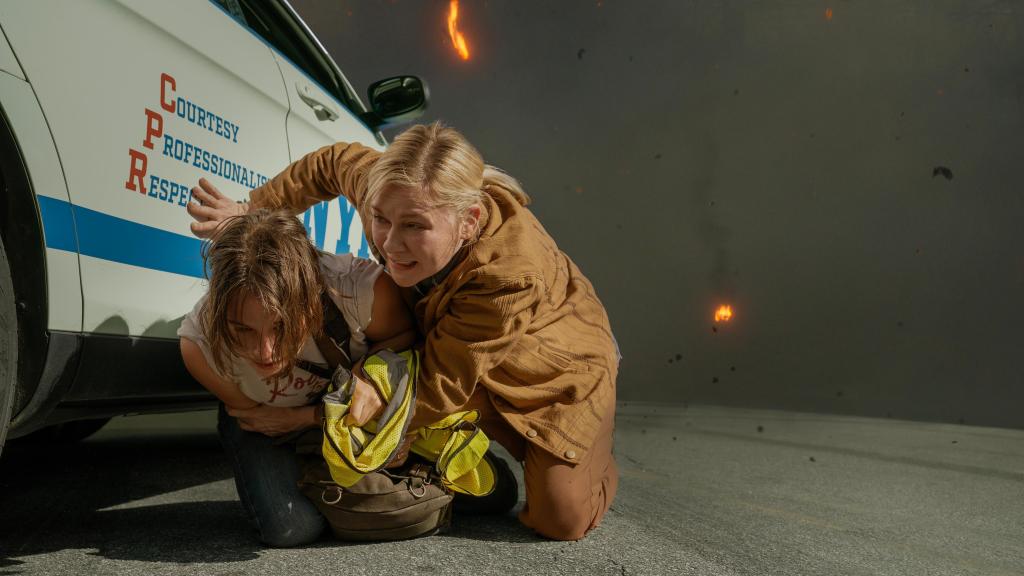
Kirsten Dunst and Cailee Spaeny in ‘Civil War.’ (Photo courtesy of SXSW/A24)
Associate Creative Director Cameron Johnson and Creative Director Kyle Heise discuss A24’s latest film “Civil War” and how the film connects with their photojournalism experiences.
Cameron’s Take:
8.5/10
“Ha,” said the Internet, when hearing “Civil War” would feature a military alliance between Texas and California.
“This isn’t what we need right now,” said I, when I first saw the previews.
“That was fantastic,” I relented, walking from the theater opening night.
“Civil War” is the ultimate “what if” of American dystopia, where APCs, tanks and morally ambiguous insurgents haunt the backroads of the East Coast. It’s a world of bombed-out tenements, gunfights and bodies strung up in the woods, cities and homes of Appalachia. Washington D.C. remains the seat of power for a fascist third-term president, while the Western Forces of Texas and California encroach slowly and steadily into enemy territory.
Kirsten Dunst is Lee. Numbed by a lifelong career in war photojournalism, she and writer Joel, played by Wagner Moura, embark on a roundabout trip to D.C., now a military stronghold where the press are shot on sight. Their story? To photograph and interview the president, whatever the cost.
Lee, wracked with trauma, and Joel, whose devil-may-care charm belies a “laugh not to cry” philosophy, are softened by the sage-like presence of Sammy, a New York Times veteran and salt-of-the-Earth mentor, played gracefully by Stephen McKinley Henderson.
The final addition to our cast, Jessie, is my new “literally me” character. At 23 years old, Jessie starts her career with the family camera and moves away to follow her dreams. She initially embarrasses herself in front of her heroes, but overcomes, impresses, creates lifelong friendships and learns from her mistakes along the way.
It would all be sunshine and apple pie if it didn’t involve horrors beyond human comprehension and Jessie’s use of a Nikon … which aren’t mutually exclusive.
After meeting Lee, Joel and Sammy, Jessie talks her way into hitching a ride to the front line in Charlottesville, Virginia. Her bright-eyed assumptions of war photojournalism are quickly scattered by Lee, who imposes a hard-edged, bear-witness philosophy. The emotionally brutal days on the road tear every bit of facade from the characters, and everyone is changed by the time they reach D.C. — there’s no emotion left to make impartiality a challenge.
“Civil War” seemed like a grand mistake at first — a sensationalized depiction of America’s political climate, preying upon the fears of extreme partisanship. Similar to how 2020’s “Songbird” used the ongoing pandemic to create its plot, it seemed like “Civil War” was using the Jan. 6 insurrection to build out its own story.
It came as a great relief to find no overt political message in this film. Of course, the idea of a second American Civil War is an inherently political concept, but opinions are left to vague recollections and open-ended questions rather than any one platform explained by the characters. The only sides we’re concerned with are the totalitarian government of D.C., the unrelenting rebellion of the Western Forces and the fly-on-the-wall approach of the press. While Lee’s belief in bearing witness and avoiding proactivity is critiqued and explored, it seems like the only “good” option left is to be an impartial observer. In the end, Lee’s actions prove otherwise, leaving us in a world with no clear good or evil, just winners, losers and those who get the story.
As photojournalists, Kyle and I have a unique perspective on this film. When I say Jessie is “literally me,” it’s genuine. It’s impossible not to consider my own professional experiences in reviewing “Civil War.”
In a particular scene, the crew stays at a World Relief Fund encampment in an abandoned football stadium. Jessie is initially excited to show Lee her photos but is completely mortified when she notices their blurriness and overexposure.
“I don’t want you to see these,” Jessie says, a sentiment every photojournalist has felt to their core. When she finds a shot she’s proud of — a rebel providing medical support to a downed soldier — Jessie hesitantly hands it to Lee.
“It’s a great picture, Jessie,” Lee says.
I remember when Michael Mulvey (a Pulitzer Prize-winning photojournalist, I’m not-so-subtly mentioning) complimented my work. I also remember when my photos for the entire first half of Texas A&M’s 2022 opening season football game were unusable due to an embarrassingly low shutter speed. And while, thankfully, I’ve never been in a warzone, I’ve been to protests and humanitarian outreach sites and have seen people at their most emotionally and physically vulnerable.
Every mistake and self-conscious overcorrection of Jessie’s was one I’ve experienced in my own career, and Cailee Speaney’s performance is completely accurate to that experience. I’ve met veteran photojournalists and role models in Michael Mulvey, Tom Burton and Marie D. De Jesús (I wish I could name everyone I’ve learned from), who between themselves have been to humanitarian crisis points and warzones, within the borders of totalitarian governments and in the faces of the ridiculously powerful. The dystopian circumstances of “Civil War” aside, Lee’s role in her world and relationship with Jessie is one I’ve seen, experienced and learned from. It’s not for me to say whether Lee’s characterization is truly accurate to their experience, but it is accurate to the large shadows they cast.
To make my point and end this review, I want to compare a line from Lee in “Civil War” said to Sammy during their first night on the road, and a quote said to me by De Jesús in 2022 as part of an article I wrote for A&M’s college newspaper, The Battalion, speaking about her coverage of the protests and under resourced conditions in her home of Puerto Rico.
Lee: “Every time I survived the warzone, I thought I was sending a warning home. ‘Don’t do this.’ But here we are.”
De Jesús: “I need to be able to live with myself. I need to be able to sleep at night. I need to be able to minimize harm. I need to know that I have done everything I can to minimize harm. I can’t be part of the trauma.”
Kyle’s Take:
9/10
Alex Garland’s latest film “Civil War” is an intense look at the U.S. through the lens of photojournalism.
“Civil War” is, first and foremost, a movie about the perils of reporting. It’s absent any explicit political commentary, but subtly critiques the U.S. with images and scenes reminiscent of real-life American news events.
Jessie, an inexperienced photographer, has an emotional episode the first time she sees beaten and bloody bodies. Lee, on the other hand, is completely desensitized. She simply asks the assailant to pose for a picture, his victims to each side. Any disgust or horror is masked with an emotionlessness that actress Kirsten Dunst nails perfectly.
The strength of “Civil War” is its ability to reflect and present the facts of a future that could happen. “Every time I survived a warzone, I thought I was sending a warning home – don’t do this. But here we are,” Lee says during the film.
The film itself acts as that warning. There are currently countries engaged in civil war, like Yemen and Syria, but the film’s setting of the American East Coast makes it a jarring, horribly relevant experience to watch.
Journalism is a presentation of the facts for a current reality. There is no speculation, no subjectivity. “Here are the facts and you figure out what to do with them,” journalism says.
This is the responsibility of a journalist, bound to report but to never take a stance. What “Civil War” does is challenge the audience to decide. Here are the facts — you figure out what to do.
Journalism has been portrayed on screen before in films such as 2015’s “Spotlight” or 2007’s “Zodiac,” but rarely has a film focused primarily on photojournalists. To see a career that I’ve been so emotionally and physically invested in on the big screen was a wholly unique movie-going experience.
Photojournalism, and journalism as a whole, is not glamorous. You are put in situations most people do not want to be in to get the story people need to see. These situations can be dangerous and horrific, as in “Civil War,” but they can also be sweet, genuine real-life moments you have the honor of capturing.
No matter the level of experience, location or area of expertise, all photojournalists have an innate sense of duty to visually document their surroundings. The photos are bigger than any one person who takes them, a mindset that “Civil War” captures excellently.
While I’ve never photographed a warzone, the drive and passion for that one shot is a universal photojournalism experience. Even in my most tired and stressful days, everything counts if I get the shot.
Sometimes I love taking photos, other times I hate it. However, “Civil War” reminded me why I do the job. The feeling of capturing a single moment in time is unrivaled, and the joy and service of telling someone else’s story is a fulfillment unlike anything else.
What are your thoughts? For more film and television reviews, keep reading SZNSMAG.com.

 SZNS MAG